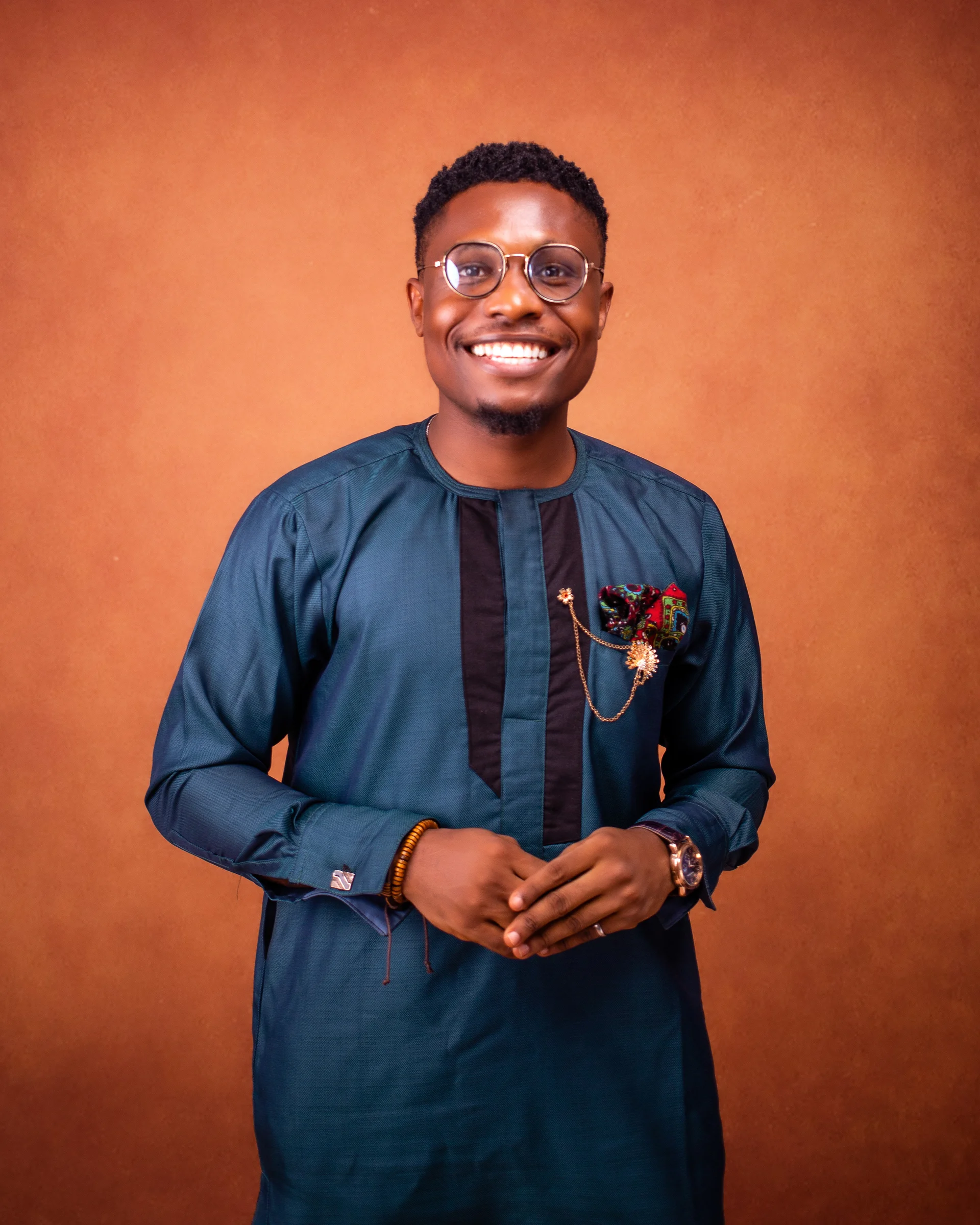
Egwu Nnanna Echem
@egwunnannaechem
Ecosystem builder, creative entrepreneur, and development advocate
Egwu Nnanna Echem is a builder, leader, and changemaker creating products, systems, and strategies that drive impact. By 2026, he had trained over 24,000 young people and supported dozens of founders in scaling their companies. An internationally recognized spoken-word poet and author, he has inspired thousands across faith-based, governmental, non-governmental, and youth gatherings, using technology and storytelling to empower people toward growth, purpose, and transformation.
La mia eredità
Some people grow up as boy wonders. Nnanna was one of them. Born of Mr. and Mrs. Egwu in a lowly part of Surulere, he was brought into the world on a celebratory note. In those early 90s, society still had a great preference for the boy child. And so he was considered special from day one.
However, being the first child also meant a lot of expectations and a lot of responsibility. It meant you could not come second place in class. It meant you could not make too many mistakes. You had to be wise before you needed to correct anything; otherwise, your siblings would get hurt. And it meant that not every game your friends played could include you.
His mother made it very clear they were not to be found in any of the video game houses, or at the tables where checkers, Ludo, chess, or any outdoor games were played, and bets were placed. Among the banned places was the primary school right on the other side of their compound's fence. There, young men would smoke marijuana and drink alcohol in the evenings and on holidays. You could literally stand on the soak-away concrete slab in the backyard and see them putting their fingers to their lips again and again. So close and yet so far because his mother forbade them from even thinking about it.
So Nnanna played a lot of street football with his mates. Sometimes when a friend was held back by their parents, he would go to their house on his reputation as a responsible boy, and never taking no for an answer, he would help finish the house chores and get them to release the friend for the game. He had early practice in taking ownership for people, for things, for outcomes.
Whether it was making meals for his siblings to eat, getting them home safe from school, or being at the selling shed to help out his mother, taking ownership was thrust on him early. He could not let things go awry. They could starve if he did not get the perishable foodstuffs in stock sold out in time. So he would sometimes arrange the items on his head tray, and hawk them around.
His parents did not pin him down to a childhood lacking in adventure either. They let him attend a church different from theirs. They let him function as a chapel prefect under the training of yet another church. They let him spend hours in theatrical rehearsals in church and far away from home.
Their openness might have had something to do with the multi-religious family they had. One of his relations was an African traditionalist. Another uncle was a Muslim who had not just been on Hajj but had lived in Medina for a time, and taken Arabic and Islamic studies at the University of Medina. One of his aunts was agnostic. His mother was deeply Christian charismatic. Yet they all lived without rancor, and he learned much from them of the value of many perspectives, and it would come to shine through in his poetry.
By his mid-twenties, Nnanna had performed and spoken on stages across Nigeria, but like many who become powerful wordsmiths later in life, the public speaker and performing artist did not always know the influence his words carried. Much of it began with leading in school morning assembly as a teenager, when he would stand before thousands of boys whose respect he had come to command, and lead them from prayer through to announcement and marching into class. And it was consolidated by an English teacher in an unexpected place.
There was a fellowship in Ijeshatedo Junior Secondary School, and that fellowship usually met during break time, and they met in a specific class in school. Nnanna and his friend were running around playing. It was his friend’s turn to try and catch him. And getting caught was the last thing Nnanna wanted. He sprinted and evaded and bounded up a building’s stairs. His friend was fast too and kept hot on his heels. At the landing, he dashed into a corridor and out of the corner of his eye saw an open classroom. He ran in.
His friend stopped pursuing him. For a moment he was relieved. Then he looked around and noticed where he had run into. Outside the door, his friend was wide-eyed because where he had run into was the meeting class of the school fellowship. Fellowship was in session, and Nnanna had run to the space they used for the altar. The preacher had stopped talking. The congregation was staring at him. For a moment he froze there, a deer in the headlights. Then he bolted for the door.
One of the ushers was quicker, blocked the doorway. No, no, said the usher; he would have to join them in the meeting. He could not protest his way out of this. From the window, his friend burst out laughing and sprang away. So Nnanna sat in their midst, sweaty shirt clinging to his skin, heavy breathing and all.
And something, says he, happened to him that day in that meeting. At some point his chest would tighten, and he would feel tangibly that God was there. That day he got "born again". A whole new vista of experiences would follow; a new chapter had begun in his life.
By JSS2 the next year, he had younger students assigned to his care. Further, he was made the assistant chapel prefect. His superior, the chapel prefect, happened to habitually arrive late to school, and so it fell to Nnanna the duty his superior should have carried out every day: to lead the morning assembly. So it was that the young boy would lead his juniors, his mates and his seniors, all standing in their lines of hundreds per class, and he would be perched up, on the balcony of a higher floor, where the teachers and principal had a view of the entire expanse of students.
He got to JSS3, was made the main chapel prefect, and continued in the role as well. On Fridays, they would go - the leaders of the fellowship – to a leadership training run by the regional headquarters of the fellowship. This was the Deeper Life Christian Fellowship. They would be taught and coached on scripture and on how to carry out their leadership duties.
This also meant that he was not free to sing just any song, even though he knew the lyrics. He was constrained even more by the expectations of people who didn't think someone of such repute should know such lyrics. That regulation which disciplines the greats had now well found its way around the teenager’s frame.
Growing up, a great influence on Nnanna was Mr. Segun Sodimu. Mr. Segun was a choirmaster; he was a mathematician; he played football sometimes, but he had a vast view of the world. It was from him Nnanna first learnt that you could be aware of life beyond your area of study. Nnanna caught the love of reading from him, and would get books from Mr. Segun to nurture that love. He was really the first outside influence to point out to the teenager his potential.
Under his tutelage, Nnanna embraced Mathematics at an age when most children grow to hate the subject, and would eventually go on to offer Further (Advanced) Mathematics in secondary school, while also being awarded the best student in English Language, a feat which wouldn't have been possible without the influence of late Mrs. Ezinwanne Eta.
Mrs. Ezinwanne Eta, after church services at the Glory Christian Ministries, would gather teenagers and teach them English language. With this weekly training, Nnanna found he was way ahead of the rest at school. Eventually, he represented the school in interschool English competitions. He would remember Mrs. Eta’s influence to be so central that he dedicated his first book, 'For The Record', to his late English teacher.
As Nnanna’s world widened, from the close where they lived in Surulere, where danfo drivers parked their buses, catered to by mechanics, vulcanizers and panel beaters, as gambling, alcohol and smoke swirled around them all day... as it widened to secondary school, and to publicly serving hundreds daily as chapel prefect, leadership trainings and Sunday tutoring... as he grew in the midst of these teachers and mentors, responsibilities and exposure, he eventually came to join a group of artists, entertainers and techies whose world would shape another phase of his life.
Nnanna had always been energetic; hard-driving. Absorbing the first principles of selling from his mother, Mrs. Bridget Egwu, he assisted in sales of perishable goods and groceries at the heavily crowded Lord's Chosen headquarters. He would also learn how to be handy from his father, Mr. Egwu Echem, who was popularly known as a contractor for various labour-intensive workers, and the locals who he would contract jobs for took to calling him 'Engineer', or 'Okoro'.
Nnanna would later join the Pater’s Heritage Mission founded by Pastor Ben Chiadika, whom he remarks was a north star for him. Pater’s Heritage Mission attracted droves of upcoming entertainment talent, some of whom would grow to become nationally famous, and Pastor Chiadika himself was heavily involved in Nollywood and in the production of popular TV shows such as Tinsel and MNET.
Among them were music producers, actors, singers, DJ’s, event planners, graphic designers, video editors… Nnanna called it his Silicon Valley. They were a community for him in the way it takes a village to raise a child. He was in their midst to witness them have quarrels and how they resolved them. He was part of their pro-level rehearsals. He escorted and helped the event planners to set up events. Wherever he could help or go on an errand, he did, and as he did, he absorbed insights no verbal instruction can teach.
When the next phase of his life rolled around Nnanna had secured admission into the University of Nigeria to study Computer Science. Straight away he sought out the artist groups on campus, from those performing at fellowships to their places of rehearsal. For one reason or the other none of them would accept him. So he formed his own group. It turned out there were other talents who had similarly been rejected, and Nnanna welcomed them to his group, CEDARS Nation.
He says it is true that trying to make a duck into an eagle is futile. He also says that as a leader he then lets the duck realize its strengths and play to those instead of trying to be an eagle. CEDARS Nation had dancers, Spokenword poets, musicians, but it also had people who were strategists, people whose job was to ensure backstage preparations were perfect, people who made sure events went according to plan. And they did not keep out any denomination of Christians.
They would go on to host the CEDARS Awards for the Christian community on campus. Artists and events were recognized, and prizes given for their impact in one of the most celebrated nights of campus that year. CEDARS Nation was Live in Concert for the event as well. During those years, he came to be friends with people who wanted to start groups of their own on campus. Godswill Ezeonyeka founded the Christ-A-Poet Team. Chukwunonso Ofortube founded the DDaniels Group.
The DDaniels Group was given an office space by the university’s Youth Friendly Resource Center, and this office became a hub for members of the three sister groups. A first-year student could walk in after class, and meet there a final year student from one of the sister groups, and strike up a conversation that led to a business venture, a Spokenword platform, a feature in an album, a friendship of a lifetime. This was community all over again, with a place for every eagle and every duck.
He joined Raadaa as their first brand ambassador, as did Nonso Ofortube, and three months after, the University of Nigeria rose to first place in Nigeria’s webometrics ranking. He got invitations to speak at various youth conferences in various states of Eastern Nigeria on personal development and business. He joined the Enugu Literary Society and performed in Dike Chukwumerije’s poetry events. He was part of the local organizing committee for TEDx UNN, the first TED event to be held in the East of Nigeria. Across ten years, he would go on to be part of the organizers for TEDx BisallaRd, TEDx Enugu, and was the primary licensee for TEDx AjaoEstate and TEDx Anthony.
The National Youth Service Corps, Kwara State, brought him on as one of 36 facilitators selected nationwide for their Entrepreneurship Development Program. In that capacity, he spoke to and trained numerous corps members, later extended to Niger and Nasarawa states. Since his campus days to date, he has spoken to and trained over 24,000 youths on business, finances, and personal development.
At the Enugu State University of Science and Technology (ESUT) he served as a Case-Study Facilitator for the Hult Prize Foundation between November 2018 and August 2019. During this time, he trained and mentored student entrepreneurs and campus groups, teaching students how to build and scale tech solutions designed to address pressing global challenges and social good.
Over time, he has co-founded a few companies as well, building the wealth of experience he now shares as an associate director at Founders Institute, Lagos, with the founders who come to be mentored there. His career has seen him work with various Tech companies, like HabariPay, Squad by GTCO, Vendease, and he is now Senior Product Manager at Bujeti.
All these experiences
In 2025, he became the first Spokenword artist to release an album and a book on the same date. He actively performs on stages across Nigeria.
Galleria



Altre eredità

Buy Phentermine Online Fast delivery service within hours for urgent orders
Buy Phentermine Online Fast delivery service within hours for urgent orders

Buy Fioricet Online Free Shipping Protected Digital Checkout Services
Fioricet Online Free Shipping Protected Digital Checkout Services

Generic Oxycontin OP 40mg Online Accelerated Online Pharmacy Fulfillment Support
Generic Oxycontin OP 40mg Online Accelerated Online Pharmacy Fulfillment Support